Mental Health
July 29, 2026
TLDR: Why You Might Swing Between Restricting and Overeating
This article explains why extreme restriction and out-of-control eating so often show up in the same person, and why the two are better understood as related trajectories than as opposite problems. Key points include:
Why people who experience both restrictive and addictive eating receive contradictory clinical advice
What a newly published life course model proposes about the shared origins of both patterns
Why the assumption that restriction always comes first does not hold up for everyone
What changes, practically, when you understand which pattern better describes your own history
Key takeaways:
Eating disorders and addiction-like eating have historically been studied and treated as separate problems, which leaves people who experience both getting conflicting guidance from different providers
A unified life course model proposes two developmental pathways — one organized around rigidity and control, one around reward and impulsivity — that often begin in shared early adversity and can converge on similar behavior later
Both pathways commonly originate in generational trauma and adverse childhood experiences, meaning the pattern has real developmental roots rather than reflecting a deficit of discipline
The direction of the loop is not fixed: for some people restriction comes first, and for others addiction-like eating comes first, and restriction shows up afterward as an attempted correction
People frequently carry features of both pathways at once and may shift between them across a lifetime, especially during stress, major transitions, or treatment itself
Wise Mind Nutrition's stance:
Treats the restriction-overeating swing as a developmental pattern to be understood, not a willpower failure to be corrected
Rejects the idea that one food philosophy fits every person with disordered eating, in either direction
Holds that a person can need more flexibility with food or less exposure to certain foods, and that assuming the answer before knowing the history causes harm
Refuses numeric targets, food rules, and quotas as a route out of the cycle
Treats family history as information about risk, never as blame or as destiny
The article concludes that the most useful question is not how do I stop swinging, but which pathway does my own history actually describe — because the honest answer to that question changes what helps.
[Read full article for the two pathways, the evidence on directionality, what this means for treatment, and full references to peer-reviewed research]
Two Extremes That Don't Feel Like Opposites
If you have ever spent a stretch of time eating "perfectly" — clean, controlled, quietly proud of yourself — and then found yourself weeks later eating in a way that felt completely outside your control, you already know one of the most confusing things about food.
The two extremes don't feel like opposites. They feel connected. Like the same problem wearing two different outfits.
They often are. And understanding why takes a great deal of the shame out of it.
Why the Advice You've Received Contradicts Itself
For decades, these were treated as separate clinical problems. Restrictive eating belonged to the eating disorder field. Feeling unable to stop eating certain foods belonged to the addiction field. The two fields developed largely in parallel, with different training, different assumptions, and different ideas about what causes what.
If you have features of both, you have probably felt the consequences of that divide personally. One provider tells you all foods fit and that the goal is flexibility. Another tells you to reduce exposure to the foods that feel impossible to stop eating. Both are describing something real. Neither is describing your whole situation. My colleagues and I have written directly about why the universal application of "all foods fit" causes harm for a meaningful subset of people, even though it is genuinely the right message for others [2].
This is not a small problem. More than half of people with bulimia nervosa and binge-eating disorder do not achieve abstinence from core symptoms with standard psychological treatment, and a recent meta-regression found no evidence that these outcomes have improved over the last four decades [3]. When treatment stalls at that rate, it is worth asking whether the models underneath it are complete.
A Different Way to Map It
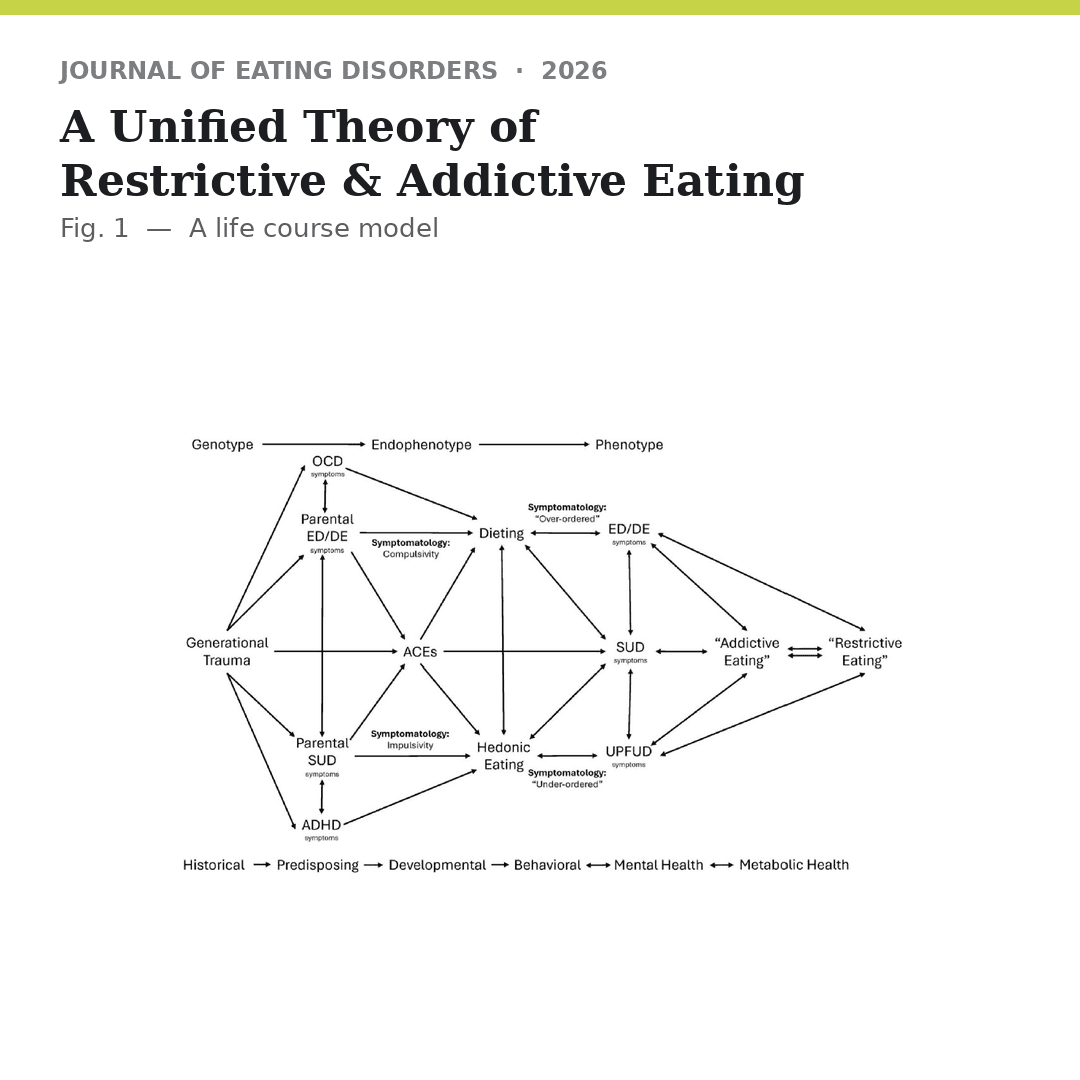
In April 2026, Alan Logan and I published a theoretical review in the Journal of Eating Disorders proposing a unified life course model of restrictive and addictive eating [1].
The core idea is this: rather than two separate conditions, there are two developmental pathways that frequently begin in the same place, diverge based on identifiable predisposing factors, and can converge on strikingly similar behavior once the pattern is established.
The Restrictive Eating Pathway tends to run through compulsivity. It is associated with family histories of disordered eating and obsessive-compulsive traits, and with an early temperament organized around rigidity, perfectionism, and discomfort with uncertainty. Food becomes a place to impose order when the surrounding environment doesn't offer any. The genetic and familial overlap here is well documented: in a large Swedish cohort study, women with obsessive-compulsive disorder had a substantially elevated risk of a later anorexia nervosa diagnosis, and the relationship ran in both directions [5].
The Addictive Eating Pathway tends to run through impulsivity and reward. It is associated with family histories of substance use disorders and attention-related traits, and with a nervous system that responds intensely to immediate reward and struggles with delay. A meta-analysis found people with ADHD had roughly four times the odds of any eating disorder, with the strongest associations for binge-type presentations rather than restrictive ones [6].
Both pathways frequently begin with generational trauma and adverse childhood experiences. In one of our studies of adults seeking nutrition counseling, post-traumatic stress symptoms accounted for essentially the entire relationship between childhood adversity and eating disorder symptoms [7]. The pattern you are living with often did not start with you.
I want to say something carefully here, because this material can land badly. Describing family history as a risk factor is not blame, and it is not prophecy. It is information. Plenty of people carry every predisposing factor in this model and never develop either pattern. The point of a life course map is not to tell you where you'll end up. It's to help explain how you got where you are.
The Direction Nobody Talks About
Here is the part that most articles on this topic leave out, and the part I most want you to have.
The dominant assumption in the eating disorder field is that restriction comes first and binge eating follows — that you deprive, your body rebels, and the rebound is the predictable consequence. That model has real empirical support, and for a great many people it is exactly what happened. Researchers have also begun testing it more precisely, including whether dietary restriction genuinely maintains binge eating in binge-eating disorder, and the answer is turning out to be more conditional than the field assumed [9].
Because sometimes it runs the other way entirely.
Some people develop addiction-like eating with no meaningful dieting history at all, and the restriction shows up afterward — as an attempt to correct something that already felt out of control. Rules, elimination, starting over on Monday. In that sequence, the restriction isn't the cause of the loss of control. It's the response to it. And it tightens the loop rather than loosening it.
This matters because of what happens when the assumption is applied universally. If you are told, repeatedly, that your loss-of-control eating must be caused by restriction, and that was never your experience, you will conclude either that you are being misunderstood or that you are lying to yourself. Neither is true. You may simply be on a different pathway.
There is also a food environment story here that deserves stating plainly. Certain ultra-processed foods have been argued, against established scientific criteria, to meet the standard for addictive substances — they deliver refined carbohydrate and fat in combinations and at speeds that don't occur in nature, and they are engineered deliberately for maximum reinforcement [8]. Addiction-like responses to these foods are common: pooled estimates put the prevalence at roughly 14% of adults worldwide, and substantially higher in clinical eating disorder samples, including 44–70% among people with anorexia nervosa [1,4]. We've covered that terrain more fully in Ultra-Processed Foods and Mental Health: What the Research Actually Says, including why the conversation so often slides into food shaming and how to keep it from doing that.
None of that is a moral claim about anyone's food choices. Access, cost, time, culture, and history all shape what ends up on a plate. But it does mean that "just have more willpower around these foods" is asking you to out-discipline a product designed by people with better funding than your prefrontal cortex.
Why This Isn't a Willpower Problem
Put the pieces together, and the willpower framing collapses on its own.
The swing between extremes is what a stressed, deprived, or over-stimulated system does. It has developmental roots, often in early adversity and in a nervous system that adapted to conditions it didn't choose. It is shaped by a food supply that changed faster than human biology did. And in many people, the two patterns aren't sequential at all — they're simultaneous, with features of both present at once and the balance shifting over time, particularly during stress, major life transitions, or treatment itself [1].
If stress and trauma are shaping your eating more than food composition is — which is true for a great many people — that deserves naming directly rather than eating around. The Biology of Stress is the better starting place, and if your nervous system has been running in anticipation of the next hard thing for years, Pre-Traumatic Stress Disorder may describe the state you're actually in.
You cannot willpower your way out of a developmental pattern. But you can understand one. That's a genuinely different project, and it's a more hopeful one.
What Changes When You Know Which Pathway Is Yours
This is the practical payoff, and it's the reason the model exists.
If your history runs through the restrictive pathway — rigidity, rules, fear, a shrinking list of acceptable foods — then flexibility is the work. Expanding, liberalizing, tolerating the discomfort of eating something unmeasured. Adding another rule, even a well-intentioned nutritional one, is likely to make things worse.
If your history runs through the addictive pathway — reward-driven, impulsive, with certain foods reliably producing loss of control — then structure may be the work, and being told to practice moderation with the exact foods that override your braking system is not neutral advice.
And if you have features of both, which is extremely common, then the answer is neither philosophy applied wholesale. It's sequencing, timing, and a clinician willing to hold two true things at once. That kind of both/and thinking is the same posture I wrote about in Purple Isn't Real, and it is the concept the Wise Mind name refers to: not a compromise between emotion and reason, but a third thing that holds both.
There are no universal answers to what or how much to eat. Someone in eating disorder recovery, someone in addiction recovery, someone carrying significant trauma, and someone following a therapeutic low-carbohydrate protocol each face genuinely different constraints. Context is not a footnote to nutrition science. It's the discipline itself.
What This Does Not Mean
Let me be direct, because this topic attracts bad actors.
This model is a theoretical framework offered as one testable scaffold among several — not a diagnosis, not a validated assessment, and not something to sort yourself into definitively from a blog post. It is a way of asking better questions about your own history.
It is also not permission for anyone to tell you that your eating is simply your parents' fault, or that identifying a pathway substitutes for care. It doesn't. If eating is dominating your days — if the swing is consuming your attention, your health, or your relationships — please work with someone. An app, including mine, is a companion to that work and not a replacement for it.
And nothing here endorses using this framework to build a stricter set of rules. If reading this makes you want to construct a new protocol, that impulse is itself worth bringing to someone.
A Practice, Not a Protocol
What Wise Mind Nutrition actually does with all of this is refuse to prescribe amounts, refuse to assign numbers, and start instead with the five components — when to eat, what to eat, how to eat, how much to eat, and how to think about food — in a sequence that adapts to where you're starting from rather than assuming everyone starts in the same place. The Gut-Brain Toolkit pairs that with DBT principles, because the food and the nervous system are not separate projects.
Over To You
Which pathway does your own history sound more like — or does it sound like both? And has anyone ever asked you that before?
I'd genuinely like to know. Tag me on Instagram.
If you want the full scientific version of this, I gave a complete talk on it. The recording lives over at FxMed Mental Health: Watch the webinar →
References
[1] Wiss DA, Logan AC. A unified theory of restrictive and addictive eating: a life course model integrating generational transmission, neurodevelopmental risk, and ultra-processed food use disorder—a theoretical review. J Eat Disord. 2026;14(1):125. PMID: 42015227. DOI: 10.1186/s40337-026-01618-6
[2] Brewerton TD, Dennis K, Wiss DA. Dismantling the myth of "all foods fit" in eating disorder treatment. J Eat Disord. 2024;12(1):60. PMID: 38760858. DOI: 10.1186/s40337-024-01017-9
[3] Messer M, Wade TD, Anderson C, Bolger T, Ng G, Bothe H, et al. Four decades of psychological treatment for bulimia nervosa and binge-eating disorder: a meta-regression of changes in abstinence rates over time. Int J Eat Disord. 2026;59(4):623-633. PMID: 41345043. DOI: 10.1002/eat.70014
[4] Praxedes DRS, Silva-Júnior AE, Macena ML, Oliveira AD, Cardoso KS, Nunes LO, et al. Prevalence of food addiction determined by the Yale Food Addiction Scale and associated factors: a systematic review with meta-analysis. Eur Eat Disord Rev. 2022;30(2):85-95. PMID: 34953001. DOI: 10.1002/erv.2878
[5] Cederlöf M, Thornton LM, Baker J, Lichtenstein P, Larsson H, Rück C, et al. Etiological overlap between obsessive-compulsive disorder and anorexia nervosa: a longitudinal cohort, multigenerational family and twin study. World Psychiatry. 2015;14(3):333-338. PMID: 26407789. DOI: 10.1002/wps.20251
[6] Nazar BP, Bernardes C, Peachey G, Sergeant J, Mattos P, Treasure J. The risk of eating disorders comorbid with attention-deficit/hyperactivity disorder: a systematic review and meta-analysis. Int J Eat Disord. 2016;49(12):1045-1057. PMID: 27859581. DOI: 10.1002/eat.22643
[7] Wiss DA, LaFata EM. Structural equation modeling of adverse childhood experiences, ultra-processed food intake, and symptoms of post-traumatic stress disorder, ultra-processed food addiction, and eating disorder among adults seeking nutrition counseling in Los Angeles, CA. Appetite. 2025;208:107938. PMID: 40031408. DOI: 10.1016/j.appet.2025.107938
[8] Gearhardt AN, DiFeliceantonio AG. Highly processed foods can be considered addictive substances based on established scientific criteria. Addiction. 2023;118(4):589-598. PMID: 36349900. DOI: 10.1111/add.16065
[9] Bartholomay J, Schaefer LM, Forester G, Crosby RD, Peterson CB, Crow SJ, et al. Evaluating dietary restriction as a maintaining factor in binge-eating disorder. Int J Eat Disord. 2024;57(5):1172-1180. PMID: 37974447. DOI: 10.1002/eat.24094


