Nutrition
July 29, 2026
TLDR: Purple Isn't Real – What Anthocyanins Teach Us About the Gut, the Brain, and Holding Two Things at Once
This article explores how anthocyanins — the pigments in purple and deeply-colored plant foods — interact with the gut-brain axis, and why the mechanism is more interesting than the headline. Key points include:
What the clinical trial evidence actually shows about flavonoids and mood
Why poor absorption turned out to be the most important finding, not a limitation
How gut microbiota convert anthocyanins into the metabolites that appear to do the work
Why purple is not a spectral color, and what that has to do with dialectical thinking
Key takeaways:
A wild blueberry intervention raised positive affect two hours post-consumption in children and young adults, with no change in negative affect — these are separate systems, not two ends of one dial
Four weeks of daily wild blueberry supplementation reduced self-reported depressive symptoms in adolescents aged 12–17, with no effect on anxiety
Anthocyanins are poorly absorbed in the small intestine; most reach the colon, where microbiota metabolize them into phenolic acids that appear to account for much of the biological activity
In NHANES data, total flavonoid intake and five of six flavonoid classes fell 50–70% across extreme quintiles of ultra-processed food contribution to total energy
The evidence is promising and incomplete: a six-week supplementation trial found blueberry inferior to placebo for depressive symptoms despite positive acute effects, and none of this constitutes treatment for anything
Wise Mind Nutrition's stance:
Treats anthocyanin research as a gut-brain story rather than a superfood story — the effect depends on the ecosystem receiving the food
Rejects detox framing and any claim that plant pigments substitute for evidence-based mental health care
Emphasizes whole-food matrices over isolated supplementation, on mechanistic grounds rather than ideological ones
Refuses universal recommendations: IBS, eating disorder recovery, and therapeutic dietary protocols each change the calculus entirely
Frames food color as an invitation to curiosity, never as a rule, a quota, or a tracked behavior
The article concludes that the most interesting thing about anthocyanins isn't what they do to you — it's what your microbiome does to them. The purple doesn't act on you. It gets translated. Which is also, not coincidentally, how your brain produces the color in the first place.
[Read full article for the clinical trial data, the bioavailability paradox, the neuroscience of non-spectral color, and full references to peer-reviewed research]
A Confession About a Color
I have been fascinated by the color purple for as long as I can remember.
It started with plants. I was the kind of kid who wanted to know why some leaves went red at the edges, and others didn't, why certain flowers deepened toward violet as they aged, why a color that felt so unnatural showed up so reliably in nature.
That fascination survived a lot of chapters — including some I didn't expect to survive myself. When I began my own recovery and had to learn to eat differently, not perfectly but differently, food stopped being a test I could pass or fail. It became something closer to a conversation. Somewhere in that conversation, the old curiosity came back. I found myself paying attention to color again, for reasons that had nothing to do with rules and everything to do with attention.
Two decades later, I have a PhD, and I've studied these pigments professionally. The obsession didn't change. The relationship to it did.
I'm telling you this because the science below is more interesting when you know it isn't neutral to me. And because what follows is not a prescription. It's a set of observations I find beautiful.
What Anthocyanins Actually Are
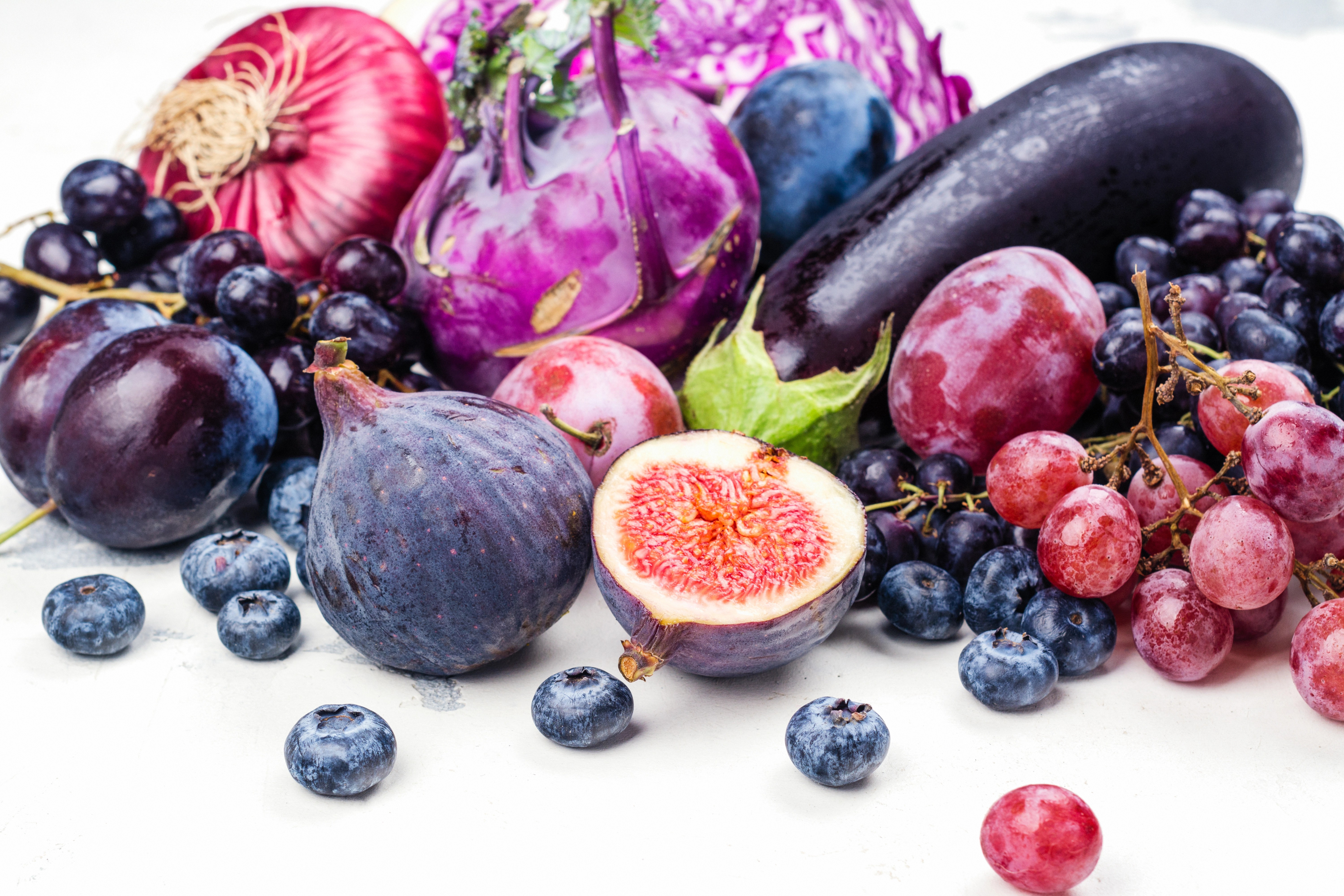
Anthocyanins are water-soluble pigments in the flavonoid class of polyphenols. They produce the red, purple, and blue-black coloring in blackberries, blueberries, black currants, elderberries, purple grapes, red cabbage, radicchio, eggplant skin, purple sweet potatoes, purple carrots, black rice, and purple corn.
Their concentration varies enormously — by cultivar, by growing conditions, by ripeness, by preparation. Two purple sweet potatoes from different varieties can differ several-fold. This is worth knowing mostly as an antidote to the false precision that food-content charts imply but don't deliver.
They are also not exotic. Most people encounter them regularly without noticing.
The Mood Evidence, Honestly Presented
Here is the finding that made me want to write this.
Researchers at the University of Reading gave children and young adults a flavonoid-rich wild blueberry drink and measured mood two hours later using the Positive and Negative Affect Schedule. Positive affect increased. Negative affect did not change at all [1].
I find that result quite remarkable, because positive and negative affect are not two ends of one dial. They are partially independent systems. The berries didn't subtract anything. They added something.
There is more:
A four-week randomized, double-blind trial in adolescents aged 12–17 found fewer self-reported depressive symptoms with daily wild blueberry supplementation compared with placebo, and no effect on anxiety [2].
In a prospective cohort of 82,643 women across the Nurses' Health Studies, higher flavonoid intake was associated with lower risk of incident depression. In late-life participants, higher intakes of all flavonoid subclasses except flavan-3-ols were associated with significantly lower risk [3]. Effect sizes were modest — pooled hazard ratios in the 0.90–0.93 range comparing highest to lowest quintiles — and the design is observational, establishing association rather than causation.
And here is the part most articles leave out — including, I suspect, most articles you'll find on this topic.
The same research group that produced the acute mood finding ran a longer trial in 60 emerging adults with moderate-to-severe depressive symptoms. A single blueberry drink improved positive affect and executive function at two hours, replicating the earlier work. But after six weeks of daily supplementation, the reduction in Beck Depression Inventory-II scores was greater in the placebo group — by 5.8 points. Anxiety and anhedonia also improved more on placebo. The authors describe this as a biphasic, possibly hormetic response, and call for further investigation [4].
Read that again, because it matters. Six weeks of wild blueberry supplementation was inferior to placebo for depressive symptoms, in a double-blind randomized trial, published by the lab most invested in finding the opposite.
I include this because a single positive acute finding is not a foundation for a health claim, and because you deserve to know that the people doing this research published the inconvenient result themselves. That is what a functioning evidence base looks like. It is also why I write about mechanism and food patterns rather than about supplements.
A note on dosage, offered carefully: the supplementation trials typically used concentrated wild blueberry preparations delivering roughly 250 mg of anthocyanins daily. I mention this only for accuracy. It is a research dose used to test a hypothesis under controlled conditions. It is not a target, and I would gently discourage anyone from treating it as one — particularly anyone for whom numbers around food have historically been difficult.
The Part That Actually Interests Me
Anthocyanins are poorly absorbed. Estimates vary, but only a small fraction of what you swallow crosses into circulation from the small intestine.
For years this looked like a problem for the field. If the compounds don't get absorbed, how can they be doing anything?
The answer reframed the question entirely. Most anthocyanins travel to the colon, where the resident microbiota metabolize them into smaller phenolic acids — and those microbial metabolites appear to account for a substantial portion of the observed biological activity [5].
The purple doesn't act on you. It gets translated.
Which means the effect is not a property of the food alone. It is a property of the relationship between the food and the ecosystem receiving it. Two people eating identical meals can produce meaningfully different metabolites depending on who lives in their gut. If you want the fuller picture of how that population is shaped by what you eat, Starve or Feed covers it directly.
This is also why I keep pointing people toward the gut-brain axis as a framework rather than a buzzword, and why our Gut-Brain Toolkit pairs nutrition science with DBT principles instead of treating them as separate domains. The signaling runs both directions, largely by way of the vagus nerve.
Why This Is Also a Food Environment Story
There's a corollary worth stating plainly.
In a nationally representative NHANES sample of 7,640 people, total flavonoid intake and five of six flavonoid classes fell by 50–70% across the extreme quintiles of ultra-processed food contribution to total energy. Only isoflavones went the other way, rising sharply — a soy-additive artifact rather than a health signal [6]. Industrial processing tends to strip the polyphenol-fiber matrix that whole plant foods deliver intact — and that matrix is precisely what the microbiota need in order to do the translating.
This is not a moral claim about anyone's food choices. Access, cost, time, culture, and history all shape what ends up on a plate, and shame has never improved a single health outcome. But it does mean that isolating anthocyanins into a capsule misses the point structurally, not just philosophically. You can't supplement your way into an ecosystem. You can only feed it.
We covered this terrain more fully in Ultra-Processed Foods and Mental Health: What the Research Actually Says, including why the conversation so often slides into food shaming and how to keep it from doing that.
Purple Isn't Real
Now the part I can't stop thinking about.
Purple is not a spectral color. There is no wavelength for it.
Violet exists on the visible spectrum, at the short end. But purple — the magenta-violet range — corresponds to no single wavelength of light anywhere. It cannot. Its position would require a frequency that is simultaneously long and short.
So your brain builds it. When long-wavelength and short-wavelength cones fire at the same time with nothing activating in between, the visual system does something extraordinary: rather than averaging the inputs into green, or picking a winner, it constructs an entirely new percept to hold both at once.
Red and blue, simultaneously. The brain refuses to choose. So it invents.
Convergence
This is where the science and the personal stop being separate things for me.
Most of the clinical work I do lives in the space between two true statements. Food is fuel and food is meaning. You can want to change and be okay exactly as you are right now. Rigor and mystery. Restriction and addiction are usually described as opposites, and in my own research I've argued they're better understood as convergent.
Wise Mind — the concept our app is built around — is the place where emotion and reason meet. Not a compromise between them. A third thing that holds both.
Which is why the brand is purple. And why the image we use is radicchio: bitter and sweet, tough and tender, red and white and violet all at once.
The color was doing this the whole time. I just needed the neuroscience to catch up to the intuition.
What This Does Not Mean
Let me be direct, because this topic attracts bad actors.
Anthocyanins are not a detox. They do not neutralize toxins in any meaningful clinical sense. They are not a treatment for any disease, and no plant pigment substitutes for evidence-based mental health care. If you encounter content claiming otherwise — and there is a great deal of it — treat the source with suspicion.
There is also no universal recommendation here. Someone managing IBS may find high-fiber berries genuinely difficult, and nervous system work may matter more than nutrient content. Someone in eating disorder recovery may find that adding another food rule, even a colorful one, does real harm. Someone following a therapeutic low-carbohydrate protocol will have different constraints entirely. Context is not a footnote to nutrition science. It's the whole discipline.
And if stress and trauma are shaping your eating more than nutrient composition is — which is true for a great many people — that deserves naming rather than nutrient-loading around. The Biology of Stress is the better starting place.
A Practice, Not a Protocol
Here is what I actually do, offered as one person's habit rather than advice.
When I'm at the store, I grab something purple. That's the whole thing. Not a rule, not a quota, not a tracked behavior. A small ongoing game with myself that keeps my attention open and occasionally puts something in my cart I wouldn't have thought to buy.
Purple and purple-tinted, if it's useful: blackberries, blueberries, black currants, elderberries, açaí, purple grapes, plums, prunes, figs, red cabbage, radicchio, eggplant, purple sweet potato, purple potatoes, purple carrots, red onion, purple cauliflower, purple asparagus, purple basil, black rice, purple corn, black beans, kalamata olives, beets.
The kid with the plants never really left. He just found better questions.
Over To You
Which of these are actually in your kitchen? And does purple carry any meaning for you — a person, a place, a season of your life?
I'd genuinely like to know. Tag me on Instagram.
References
[1] Khalid S, Barfoot KL, May G, Lamport DJ, Reynolds SA, Williams CM. Effects of acute blueberry flavonoids on mood in children and young adults. Nutrients. 2017;9(2):158. PMID: 28230732. DOI: 10.3390/nu9020158
[2] Fisk J, Khalid S, Reynolds SA, Williams CM. Effect of 4 weeks daily wild blueberry supplementation on symptoms of depression in adolescents. Br J Nutr. 2020;124(2):181-188. PMID: 32151287. DOI: 10.1017/S0007114520000926
[3] Chang SC, Cassidy A, Willett WC, Rimm EB, O'Reilly EJ, Okereke OI. Dietary flavonoid intake and risk of incident depression in midlife and older women. Am J Clin Nutr. 2016;104(3):704-714. PMID: 27413131. DOI: 10.3945/ajcn.115.124545
[4] Velichkov M, Bezur Z, van Reekum CM, Williams CM. A biphasic response to blueberry supplementation on depressive symptoms in emerging adults: a double-blind randomized controlled trial. Eur J Nutr. 2024;63(4):1071-1088. PMID: 38300292. DOI: 10.1007/s00394-023-03311-9
[5] Loo YT, Howell K, Chan M, Zhang P, Ng K. Modulation of the human gut microbiota by phenolics and phenolic fiber-rich foods. Compr Rev Food Sci Food Saf. 2020;19(4):1268-1298. PMID: 33337077. DOI: 10.1111/1541-4337.12563
[6] Leitão AE, Roschel H, Oliveira-Júnior G, Genario R, Franco T, Monteiro CA, Martinez-Steele E. Association between ultra-processed food and flavonoid intakes in a nationally representative sample of the US population. Br J Nutr. 2023;131(6):1074-1083. PMID: 37936338. DOI: 10.1017/S0007114523002568


