Nutrition
November 15, 2026
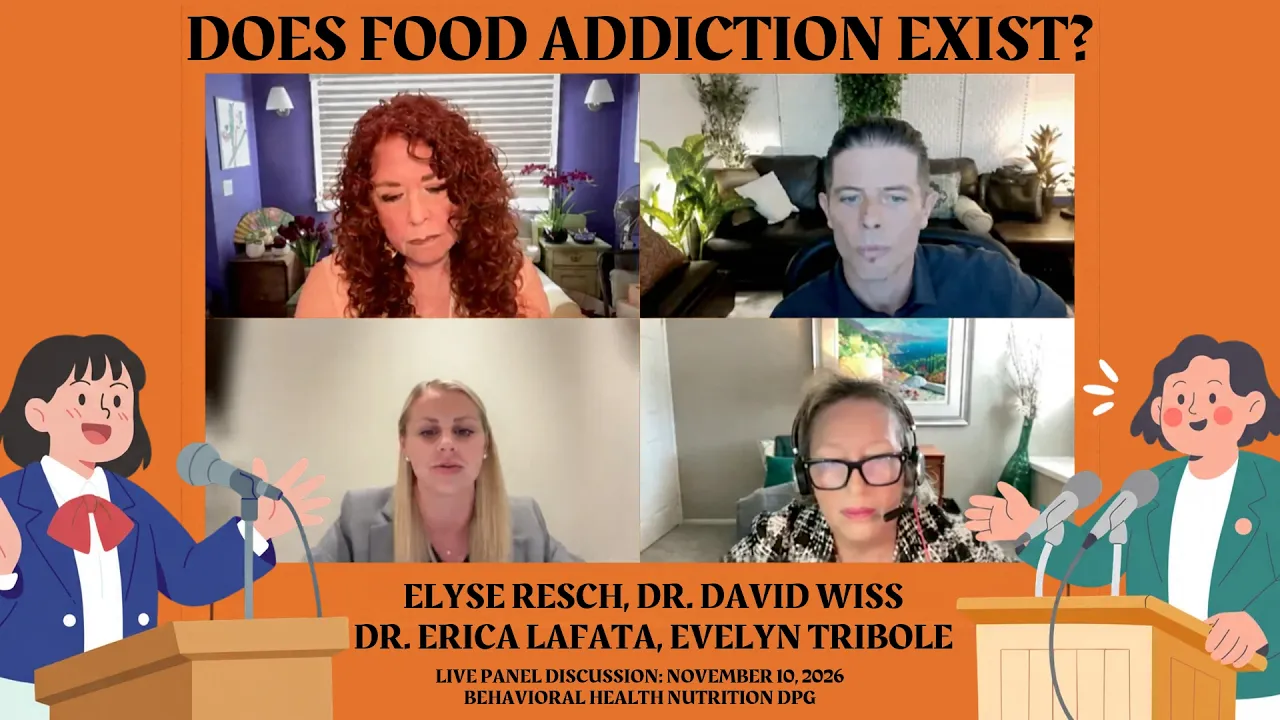
TLDR: I joined a food addiction panel with Dr. Erica LaFata and the co-creators of Intuitive Eating, Evelyn Tribole and Elyse Resch.
I stayed out of the science and focused on polarization, and the hour turned into a live case study of it. This post covers:
Why no clinician’s vantage point is free of selection bias, including mine
What four decades of stalled bulimia and binge eating outcomes suggest about the restraint model
A “weight loss” moment that showed values overriding science
The patterns that keep this debate stuck, and the common ground that could unstick it
The question isn’t whether Intuitive Eating helps. We know it can help. It’s whether any single framework gets to be the only one.
I’ve spent more than a decade publishing on the overlap between eating disorders and ultra-processed food addiction. So, when the Behavioral Health Nutrition Dietetic Practice Group of the Academy of Nutrition and Dietetics invited me onto a panel with Dr. Erica LaFata and the co-creators of Intuitive Eating, Evelyn Tribole and Elyse Resch, I decided on an approach before we went live.
I wanted to stay out of the scientific debate on the live panel, so I’ll bring in a little here. An hour split four ways isn’t enough, and Dr. LaFata is the right voice on dopamine and diagnostics. My lane was the polarization. As I said in my opening, there isn’t much debate in neuroscience and addiction; “the concentration of the polarization exists in the nutrition field.” The conversation gets confusing when science gets blended with values. In the eating disorder world, the concept hasn’t just been controversial; it’s been vehemently opposed by some groups [1].
I didn’t expect the hour to become a live case study of this social phenomenon 🤔
The Bias Nobody Would Claim
Midway through, I made a point every clinician should sit with. We attract patients who fit our practice, grow confident in our approach, then go looking for papers that confirm it. I volunteered my own example: I’ve built a niche around substance use disorders, so I “naturally attract people that have more of an addiction history.” My own data show it. In a study of 304 adults seeking nutrition counseling in my practice, more than half reported a lifetime substance use disorder, and half reported four or more adverse childhood experiences [2]. That’s a bias. I name it so I can work around it, always considering counterfactuals and competing claims.
We’ve published on exactly this. Clinicians using abstinence-based approaches see the success stories, eating disorder professionals see the people who were harmed, and each camp mostly witnesses the fallout from the other’s philosophy [3].
Elyse responded that she’d been doing this work for almost 45 years, well before Intuitive Eating came out, “so there was no bias there.” Evelyn followed with “I wouldn’t really call that a bias,” pointing to about 350 studies now supporting Intuitive Eating.
I offered self-examination first and named my biases. Neither of them reciprocated. They said they were unbiased, while basing their opinions on their practice and extrapolating them to their entire population. This is a non-starter in academics. It’s what I’d anticipated in my opening, when I said conversations about science get blended with conversations about values. I knew it was headed this way.
The question was never whether Intuitive Eating helps. It has helped an enormous number of chronic dieters. The question is whether anyone’s clinical vantage point is free of selection effects. Mine isn’t. As I wrote in Who Really Benefits from the Eating Disorder Culture Wars?, no one is immune to bias.
Four Decades
Here’s the part I keep coming back to.
Elyse offered her four-plus decades of practice as proof that bias didn’t apply to her. Her central argument was that if food were addictive, clients “would continue to feel out of control when given those foods,” based on her “lived experience with a multitude of clients.” She told us she stays in touch with many of them, and that their progress sticks. I believe her. But think about who stays in touch with their dietitian for decades… usually the folks it worked for. That isn’t a knock on Elyse. It’s how selection bias works for every one of us.
It’s also a logic problem. Many people habituate to rewarding foods without that suggesting nobody has an addictive response. Most people who drink never develop alcohol use disorder, and nobody concludes alcoholism doesn’t exist. Prevalence estimates for ultra-processed food addiction closely mirror those of other substance-related problems [4]. I first made this both/and case in Understanding Resistance to the Concept of “Addiction” as it Relates to Food and Sex. Dr. LaFata said it best in her closing: “there are also people for whom that is not true.”
Long experience, mine included, can simply mean more years of reinforcing what you already believe. And the world our patients eat in has changed since the first edition of Intuitive Eating in 1995: a far more ultra-processed food supply [5], relentless marketing of those foods to children, an opioid crisis, and screen-based behavioral addictions. Holding the same position through all of that isn’t consistency. It’s defending the sandcastle while the tide comes in. This happens frequently, even at the highest academic levels. It’s human nature, and I understand the defense response.
Then there’s the data. A meta-regression in the International Journal of Eating Disorders pooled 99 randomized trials of psychological treatment for bulimia nervosa and binge eating disorder, spanning roughly four decades [6]. Pooled abstinence from binge eating and/or purging was 29% for bulimia nervosa and 43% for binge eating disorder. The authors found no observable improvement in outcomes over four decades, and for binge eating disorder, a decline over time under certain conditions.
To be precise, those trials tested front-line psychotherapies (mostly CBT), not Intuitive Eating, and there are limited data on Intuitive Eating-based interventions for eating disorders at all [1]. But the leading cognitive-behavioral model of bulimia and binge eating puts dietary restraint at the center [7]: rigid food rules drive the binge, so treatment works to loosen them. That’s essentially the theory Elyse gave as her bottom line. Those stalled outcomes are, in large part, the outcomes of treatment built on the restraint model.
So, here’s my question. If outcomes have stalled for forty years, why defend the existing framework even harder? The authors call for a shift in how treatments are conceptualized and tested. To me, that shift should include the possibility that some people with binge-type presentations need something different, and early data point that way. In our 12-month follow-up of an online, low-carbohydrate, psychoeducational program, food addiction symptoms and mental well-being improved and stayed improved [8]. Another analysis we co-authored, of a similar abstinence-based program, found that binge eating severity dropped and largely held at six months, with no evidence of worsening [9]. Neither had a control group, both enrolled people who already saw themselves as food-addicted, and the 12-month study followed up about half its original cohort. They’re a starting point, not proof. But the binge eating findings are hard to square with the claim that any limit on specific foods makes binge eating worse. My colleagues and I laid out the broader case in Dismantling the Myth of “All Foods Fit” [10].
That was the biggest example of bias on the panel: four decades of personal experience offered as proof against bias, in a corner of the field where restraint-centered treatments have plateaued.
The “Weight Loss” Moment
Dr. LaFata described a subtype of overeating driven more by negative affect, where harm reduction (not abstinence) approaches have worked, “including just gold standard behavioral weight loss.” Evelyn repeated “weight loss” back with a smirk. (The recording is available, so you can watch it yourself.)
It was exactly what I’d described in my opening: a scientific point met with a values-level reaction. Dr. LaFata wasn’t prescribing weight loss. She was reporting a finding for one subtype. You can debate a finding. A smirk isn’t a counterargument. It’s a signal of social disapproval, sent to the in-group. I wonder if Evelyn even realizes she did this (she might not).
Later, Elyse said she has “certainly had clients who have lost weight as a result of not bingeing anymore.” When an audience member asked whether they were anti-weight loss, they raised weight cycling and the starvation that can come with intentional weight loss. Legitimate concerns, and I share them. But notice the pattern. Weight loss is acceptable when it shows up inside their framework and is suspect when it shows up in someone else’s data. For the record, I’ve argued in print that treating food addiction should not be synonymous with weight loss [4], and our 12-month program paper says plainly that treatment shouldn’t overemphasize it [8].
A smirk at two words is a small thing. It’s also the culture war in a single facial expression 🤷🏻♂️
A Few More Patterns Worth Naming
“Restriction causes it all.” Elyse’s bottom line was that restriction and restraint cause the behaviors labeled addictive, not the foods themselves. For many people, that’s true. As a universal claim, it isn’t. A longitudinal study of adolescents found that food addiction predicted later dietary restraint, while restraint didn’t predict later food addiction [11]. It’s one small study, but it shows the arrow can point both ways. There was a lovely both/and moment, too. Right after I described the generational transmission of addiction, Evelyn said, “I agree with the legacy of trauma,” then added the legacy of diet culture (“grandma’s been dieting, mom’s been dieting”). Both are real. That’s the structure of the Unified Theory that Alan Logan and I published this year: a restrictive pathway that often runs through parental disordered eating, an addictive pathway that often runs through parental addiction, and generational trauma underneath both [12].
Selective evidence. Evelyn asked for a “preponderance of evidence” before this construct becomes diagnostic. Fair enough. But a preponderance means weighing it all. Every study Evelyn cited on the panel cut against the construct: a critique of the Yale Food Addiction Scale, a milkshake PET study [13] (challenged in a letter arguing that PET imaging can miss dopamine responses, as it can for nicotine and alcohol [14]), a review of brain imaging studies (with heterogeneous methodology), a food classification exercise. She acknowledged the size of the literature, but treated its volume as a weakness rather than engaging with the evidence that doesn’t rest on the questionnaire at all: clinical-interview validation, prospective data, overlapping neurobiology, and early treatment outcomes.
The standards are uneven, too. Yale Food Addiction Scale research was treated as suspect for relying on self-report, a fair limitation that Dr. LaFata acknowledged. But criticizing the YFAS for being self-report while not acknowledging that the Intuitive Eating Scale is also self-report seemed a little uneven.
But as Dr. LaFata noted, self-report “is a starting place for all diagnoses that have ever come to be,” and her lab has since built a clinical interview tool to address exactly that limitation. I’ve argued for years that food addiction scores should be read alongside dietary restraint and other psychiatric diagnoses, so restrained eaters aren’t misclassified [15]. Ultra-processed food addiction is also held to a biological standard that, per Dr. LaFata, no established substance use disorder meets (nicotine included).
I’m not arguing the neuroscience here. I’m noticing that the bar moves depending on which conclusion the evidence supports. That’s not a scientific disagreement. It’s a confirmation bias problem.
Naming bias on your own side. Evelyn’s sharpest question was why the consensus statement calling ultra-processed food addiction a disease didn’t include divergent voices. I said “I agree with that,” and I meant it. That paper came out of a conference of people who already accept food addiction, and it carries its own in-group bias. The DSM application now underway is drawing in a wider range of scientists and stakeholders, as it should. I named the bias on my own side, not just the other one.
Same talking points, different year. Evelyn opened with “I believe that food addiction remains a theory.” She closed with “I still believe that food addiction remains a theory.” In between, Dr. LaFata described a clinical interview tool her lab developed that makes the overlap with anorexia “almost negligible.” Evelyn’s position didn’t move. The other objections were familiar too, like Twinkies sharing a category with veggie patties (“have you seen anyone addicted to veggie patties?”). Dr. LaFata’s reply: alcohol policy doesn’t focus on kombucha either. I’ve heard these same objections circulating as settled fact for a decade. The science has moved on. The objections haven’t. We’ve been hearing the same recycled talking points at eating disorder conferences, and no amount of evidence has changed them.
Some will say my position hasn’t moved either. It has, from a 2017 guide for bringing food addiction into eating disorder care [16], to a 2020 framework for telling food addiction apart from dietary restraint [15], to this year’s Unified Theory [12]. But the movement the field is waiting for isn’t mine. Many younger clinicians I talk to accept the science but tiptoe around it in public, waiting for the field’s most respected voices to make it safe to say out loud. Until then, progress is stifled. In my opinion, that’s exactly what the food industry wants.
The Sandcastle
In early 2024, I wrote in How I Overcame the Rigidity of My Mind and the Toxicity of the Nutrition Profession: “My fear is that some are too rigid and would rather spend the rest of their career defending their sandcastle.”
In my closing statement on the panel, I said that anyone declaring food addiction doesn’t exist should have real qualifications in addiction, neuroscience, and research, and that this claim “does reek of intellectual conflict of interest.” I stand by that. I mean intellectual, not financial. This isn’t about book sales. It’s about legacy. When a framework carries your name and has defined decades of your career, changing your mind costs something more personal than money. All of us who’ve built careers on a model carry some version of that (me included). Our research team has called for clinicians from different schools of thought to stop opposing one another “from deeply established intellectual allegiances” [8].
Here’s what struck me most: the clinical overlap is enormous. Dr. LaFata said she fully supports “the clinical perspectives that have been shared from intuitive eating” and called ultra-processed food addiction treatment weight neutral, with gentle nutrition in common. Elyse agreed that not everyone has been on a diet. Evelyn agreed that “nuance is really important.” And I said it out loud: “I get a sense that we do very similar work” (we shared a genuine smile).
That common ground extends to the food system. All four of us voiced concern for families with limited access to anything but ultra-processed foods (consumption is in fact higher among lower-income groups in the U.S. [5]), and Evelyn agreed that Commercial Determinants of Health are very important, adding the weight-loss industry to the list. Fair point.
So, who pays for the fight? Patients pay most, and practitioners pay too. As I said on the panel, patients “feel like they have to choose between different camps, and they oscillate between practitioners and treatment centers.” Our abstinence paper’s case vignettes show exactly that back-and-forth [3]. If reducing black-and-white thinking is a goal of eating disorder treatment, providers have to reduce it around food philosophies too [1], a point I’ve been making since How the Nutrition Field Became Toxic and What We Can Do About It.
Hard on Structures, Soft on People
I’ve leaned on this principle from john a. powell: be hard on structures, soft on people. Does this post break that rule? It strains it a little.
Naming a smirk and a résumé isn’t soft. But when two people are the architects of the dominant framework in a field, the line between person and structure blurs. I’ve stuck to the record, and where I’ve named a motive (legacy), I’ve applied the same lens to myself. Evelyn actually modeled the distinction when she told me, “I don’t have a problem with you, David.” I don’t have a problem with her either, or with Elyse. My problem is with any framework that insists it’s the only one, especially when the outcomes in its own corner of the field haven’t moved in four decades.
What This Does Not Mean
This isn’t a case against Intuitive Eating, which I use parts of clinically. It isn’t a claim that restriction doesn’t matter; for many people it’s the main driver of out-of-control eating, and nourishment comes first.
It isn’t a suggestion that everyone who feels out of control around food has ultra-processed food addiction. That takes careful assessment, well beyond a single questionnaire [4, 15]. The overlap with existing eating disorders is real (more than half of people with a clinical binge eating diagnosis screen positive for food addiction [17]), but as Dr. LaFata pointed out on the panel, most people who meet criteria for food addiction don’t have an eating disorder. And of those that do, many of them developed restrictive patterns of disordered eating to manage an addictive response to foods [2, 11, 12].
If you have a history of restrictive eating, please don’t read this as a reason to start cutting out foods on your own. Approaches that limit specific foods belong with a clinician who knows your history and can tell the difference between an adaptive boundary and a new rule [3, 15]. I am one of them, and I do know many others. The Wise Mind Nutrition app can also help.
Breaking or Bridging?
Near the end, Evelyn suggested we bring this conversation to FNCE. Eleven hundred registrants to the panel highlight professional interest. I’m open to it. And credit to BHN for putting both perspectives on one stage. My biggest concern is that it becomes more of the same: doubt and delay, which, intended or not, is exactly what the industry playbook needs. I think we’ve reached the tipping point. Many of my colleagues agree.
This conversation should have happened at FNCE ten years ago, but it's happening now, so I feel a sense of duty to be here for it. The question is whether it’s treated like a breaking moment or a bridging moment…
I know which one our patients need. I know which one practitioners need, too: in an international survey, 60% of health professionals and trainees wanted training on addictive eating, and 72% said patients had already asked them about it [18].
Over to You
If you’re a clinician, where have you felt pressure to pick a camp? And if you’ve been a patient caught between them, what would have helped?
I’d genuinely like to know. Tag me on Instagram.
Onward 🌱
References
Wiss DA, Brewerton TD. Can intuitive eating be helpful to individuals with ultra-processed food addiction? In: Avena NM, ed. Hedonic Eating: How the Pleasure of Food Affects Our Brains and Behavior. 2nd ed. Oxford University Press; 2025:160-172. DOI: 10.1093/med/9780197688908.003.0009 (book chapter; not indexed in PubMed)
Wiss DA, LaFata EM. Structural equation modeling of adverse childhood experiences, ultra-processed food intake, and symptoms of post-traumatic stress disorder, ultra-processed food addiction, and eating disorder among adults seeking nutrition counseling in Los Angeles, CA. Appetite. 2025;208:107938. PMID: 40031408. DOI: 10.1016/j.appet.2025.107938
Thompson SP, Jacobs MJ, Wiss DA. Abstinence-based treatment of comorbid eating disorders and ultra-processed food addiction. Front Psychiatry. 2025;16:1586490. PMID: 40698052. DOI: 10.3389/fpsyt.2025.1586490
Wiss D. Clinical considerations of ultra-processed food addiction across weight classes: an eating disorder treatment and care perspective. Curr Addict Rep. 2022;9:255-267. PMID: 35531579. DOI: 10.1007/s40429-022-00411-0
Wiss DA, LaFata EM. Ultra-processed foods and mental health: where do eating disorders fit into the puzzle? Nutrients. 2024;16(12):1955. PMID: 38931309. DOI: 10.3390/nu16121955
Messer M, Wade TD, Anderson C, Bolger T, Ng G, Bothe H, et al. Four decades of psychological treatment for bulimia nervosa and binge-eating disorder: a meta-regression of changes in abstinence rates over time. Int J Eat Disord. 2026;59(4):623-633. PMID: 41345043. DOI: 10.1002/eat.70014
Fairburn CG, Cooper Z, Shafran R. Cognitive behaviour therapy for eating disorders: a “transdiagnostic” theory and treatment. Behav Res Ther. 2003;41(5):509-528. PMID: 12711261. DOI: 10.1016/S0005-7967(02)00088-8
Unwin J, Delon C, Giæver H, Kennedy C, Painschab M, Sandin F, et al. Low carbohydrate and psychoeducational programs show promise for the treatment of ultra-processed food addiction: 12-month follow-up. Front Psychiatry. 2025;16:1556988. PMID: 40357512. DOI: 10.3389/fpsyt.2025.1556988
Bennett E, Bellamy EL, Lycett D, Unwin J, Whelan M, Wiss DA, et al. Changes in binge eating symptoms following an online community-based ultra-processed food addiction intervention: Liberate. Front Public Health. 2026;14:1807450. PMID: 42254632. DOI: 10.3389/fpubh.2026.1807450
Brewerton TD, Dennis K, Wiss DA. Dismantling the myth of “all foods fit” in eating disorder treatment. J Eat Disord. 2024;12:60. PMID: 38760858. DOI: 10.1186/s40337-024-01017-9
Rios JM, Berg MK, Gearhardt AN. Evaluating bidirectional predictive pathways between dietary restraint and food addiction in adolescents. Nutrients. 2023;15(13):2977. PMID: 37447303. DOI: 10.3390/nu15132977
Wiss DA, Logan AC. A unified theory of restrictive and addictive eating: a life course model integrating generational transmission, neurodevelopmental risk, and ultra-processed food use disorder: a theoretical review. J Eat Disord. 2026;14:125. PMID: 42015227. DOI: 10.1186/s40337-026-01618-6
Darcey VL, Guo J, Chi M, Chung ST, Courville AB, Gallagher I, et al. Brain dopamine responses to ultra-processed milkshakes are highly variable and not significantly related to adiposity in humans. Cell Metab. 2025;37(3):616-628.e5. PMID: 40043691. DOI: 10.1016/j.cmet.2025.02.002
Avena NM, Gold MS, Gearhardt AN. Missed signals: how PET imaging may fail to capture the addictive potential of ultra-processed foods. Cell Metab. 2025;37(8):1621. PMID: 40769123. DOI: 10.1016/j.cmet.2025.06.007
Wiss D, Brewerton T. Separating the signal from the noise: how psychiatric diagnoses can help discern food addiction from dietary restraint. Nutrients. 2020;12(10):2937. PMID: 32992768. DOI: 10.3390/nu12102937
Wiss DA, Brewerton TD. Incorporating food addiction into disordered eating: the disordered eating food addiction nutrition guide (DEFANG). Eat Weight Disord. 2017;22(1):49-59. PMID: 27943202. DOI: 10.1007/s40519-016-0344-y
Praxedes DRS, Silva-Júnior AE, Macena ML, Oliveira AD, Cardoso KS, Nunes LO, et al. Prevalence of food addiction determined by the Yale Food Addiction Scale and associated factors: a systematic review with meta-analysis. Eur Eat Disord Rev. 2022;30(2):85-95. PMID: 34953001. DOI: 10.1002/erv.2878
Burrows T, Verdejo-Garcia A, Carter A, Brown RM, Andrews ZB, Dayas CV, et al. Health professionals’ and health professional trainees’ views on addictive eating behaviours: a cross-sectional survey. Nutrients. 2020;12(9):2860. PMID: 32962008. DOI: 10.3390/nu12092860


